- Revecore Insights
- Underpayment Recovery
Where the Other Half of Your Underpayments Are Hiding
September 10, 2026

In the first post in this series, we looked at why payment variance tools structurally can't catch billing errors, documentation gaps, or payer policy misapplication. Those categories account for roughly 30% of underpayment recoveries once someone goes looking. The larger share, more than half, comes from somewhere revenue cycle teams have already stopped looking: zero-balance accounts.
A zero balance tells a clean story. The claim was submitted, the payer responded, the account closed, and the team moved on to the next thing in the queue. Most revenue cycle systems are built around that assumption, and reasonably so. Work queues exist to surface open balances and unresolved denials, not to reopen files that already reached zero. The trouble is that reaching zero and being paid correctly are not the same event, and for a meaningful share of closed accounts, they never were.
Hidden Denials Don't Always Look Like Denials
Some of what sits in a closed-account file is what's often called a hidden denial. A payer issues what functions as a denial, but instead of generating an open balance and a workflow, it processes as a zero-balance adjustment. Nothing trips an alert. No task gets created. The account simply disappears into the archive looking resolved.
Other accounts hold known denials that staff identified and started to work, then set aside when the appeal got complicated or the deadline pressure from a hundred other open cases won out. Either way, the money never moves, and the account never comes back up for a second look.
The dollars involved are substantial. Combined Medicare and Medicaid underpayments reached $130 billion in 2023, and the American Hospital Association has found those shortfalls have been growing at roughly 14% a year since 2019.
Denials themselves are climbing too. HFMA reports that Medicare Advantage denials have risen nearly 56% and commercial denials over 20% in recent tracking, and that reworking a single denial now costs providers an average of $47.77 for MA claims and $63.76 for commercial ones.
Across roughly three billion claims submitted annually, that adds up to close to $20 billion a year just in the administrative cost of chasing money that was already earned, before a dollar of it comes back.
Why Zero-Balance Underpayments Don't Come Back on Their Own
The reasons these accounts stay closed are rarely about whether the appeal would succeed. Premier's research found that 54.3% of denied claims across private payers were ultimately overturned when pursued, which means the majority of the time, fighting for the money works.
What gets in the way is bandwidth. Coders and billers are already stretched thin, appeal windows vary by payer and close fast, and the complexity of a given denial doesn't always match the time available to work it. A claim doesn't have to be unwinnable to get written off. It just has to be inconvenient at the moment someone has to decide what to prioritize.
That points to a resourcing problem, and it calls for a different fix than most teams reach for first.
Treating Zero-Balance Denial Recovery as Its Own Workstream
Health systems that see meaningfully better recovery results tend to treat zero-balance and denial review as a dedicated function, not a task list that gets picked up when capacity allows. That distinction matters for two reasons.
It means someone is looking at closed accounts on a regular cadence, rather than only when a denial is fresh and still inside its appeal window.
It means the patterns that surface—a specific payer repeatedly misapplying a bundling rule, a recurring documentation gap tied to one service line—get fed back into current processes and into payer contract conversations, instead of getting re-discovered from scratch every time.
That second point is easy to underestimate. When a health system can show a payer clear, claim-level evidence of a repeated coverage misapplication across a defined patient population, the conversation shifts from a dispute over one bill to a pattern the payer has to answer for. Heading into a contract renegotiation, that's a far stronger position to argue from.
Recovering this kind of revenue takes clinical and coding expertise, familiarity with how each payer's appeal pathway works, and the persistence to see a multi-round appeal through.
It's the kind of work firms like Revecore are built to run at scale, applying rules-based and machine-learning models across historical claims data to prioritize which closed accounts are worth reopening first. That review typically runs on a contingency basis, so it carries no added cost to the health system, just someone with the time and specialization to look at accounts everyone else already marked closed.
Find More Revenue Hidden in Your Underpayment Data
Curious how dedicated zero-balance recovery works?
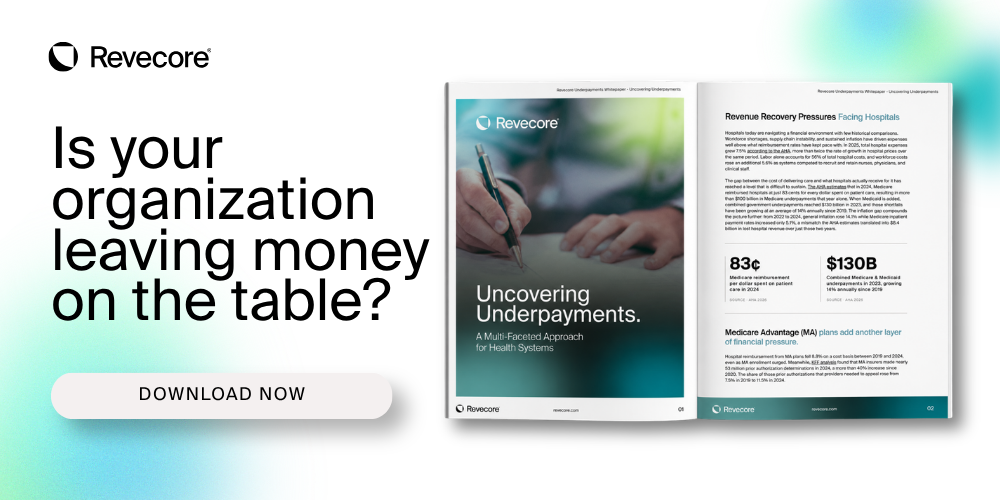
Uncovering Underpayments: A Multi-Faceted Approach for Health Systems goes deeper on hidden denials, proactive denial management, and the specialization it takes to recover revenue hospitals have already written off.
Similar Content
-

- Revecore Insights
Why Complex Claims Need a Different Revenue Cycle Strategy
September 17, 2026
-

- Revecore Insights
One in Five Insured Patients Was Denied Care Last Year. Hospitals Are Absorbing the Fallout.
September 16, 2026
-

- Revecore Insights
Offense or Defense? How Health Systems Can Fight Back Against Payer AI
September 1, 2026


