- Revecore Insights
AI Demystified: What Machine Learning Really Means for Revenue Cycle Leaders
August 26, 2026

AI is front and center in RCM right now, but most conversations about it are full of jargon and hype. This Revecore coffee chat cuts through the noise with a clear breakdown of what AI and machine learning actually are, what they're good at, where they fall short, and how revenue cycle leaders can start using them without a technical background.
Angela Troccoli, Head of Marketing at Revecore, sits down with Firoze Lafeer, Senior VP of Data Engineering at Revecore, for a practical, jargon-free conversation covering what “AI” really means, why ChatGPT changed the conversation overnight, what hallucinations are and why they happen, and how to separate genuinely useful tools from vendor noise.
Watch the full conversation
The Conversation
What Does AI Really Mean in Healthcare Revenue Cycle Management?
Firoze: AI is a very big word. Some of what falls under that umbrella has existed for 30 or 40 years, and some of it is what everyone started hearing about in just the past two or three. The ChatGPT moment is a particular type of AI built for a particular purpose. People have since stretched that into all kinds of other things, but it's important to keep it in perspective: it's one tool among many. There are plenty of other techniques in AI, machine learning, and data science that have long been part of how we operate, and will continue to be part of what we build going forward.
Why Did ChatGPT Change the Conversation Around AI?
Firoze: It's a bit like walking into McDonald's and thinking that's the first hamburger you've ever heard of — you'd be forgiven, because it's on every corner, it's inexpensive, and it's everywhere. But there were hamburgers before McDonald's, and food long before that. What ChatGPT did was make the underlying technology accessible and immediate. You sit down, ask a question, and get an answer. Whether that answer is correct is a separate issue, but it feels immediate.
Historically, building a machine learning model meant going through a team of specialists — there was a layer of translation, and you never really saw behind the curtain. ChatGPT removed that layer. You open a browser, ask a question, and get a fast answer that's tuned to feel human and to please you. OpenAI took a technology many people already knew existed and gave it a friendly face, made it free, and about eight billion people “joined the chat,” as my son puts it.
How Do AI and Machine Learning Actually Work?
Firoze: These tools are friendly, but they're also very authoritative — they'll tell you “this is your answer” or even coach you, almost like a human would. But they're not human. They mimic some slice of human intelligence, but what's really happening is large-scale pattern matching. When you type a question into ChatGPT, it isn't understanding “weather” or “Washington” or even the word “what.” It's going token by token, asking, “Given everything I've been trained on, what's the most likely next token?” There's some reinforcement learning layered on top, but at its core, it's a lot of math at scale — very good science, but not intelligence in the way people usually mean it.
What Are AI Hallucinations and Why Do They Matter in Healthcare?
Firoze: People do this too. If you sit someone down for a test and tell them they get zero points for not answering but at least something for trying, they'll make something up. That's the primary reason these tools will answer a question even at the expense of inventing information — they're not truly understanding what they're saying either. The math works out that a given answer is the most probable one, and when the system doesn't actually know the answer, that probability exercise becomes a guess.
The takeaway is: be careful, especially when the stakes are real. There's a real difference between using a tool like this to plan a vacation versus doing serious work on behalf of hospitals, which is what we do. For that kind of work, “correct” has to mean something much more rigorous. It comes down to knowing the tool's strengths, knowing its weaknesses, and putting the right controls in place — both to avoid encouraging a bad answer and to catch one that wasn't correct.
How Should Revenue Cycle Leaders Start Using AI?
Firoze: Start with the free tools. Ten years ago, if you'd proposed using AI to improve revenue cycle, the response would have been, “That's a science project, no one's putting real money into that.” Free, accessible tools have changed that — everyone can now picture what's possible, and everyone can actually try it themselves.
That hands-on experience matters, because it teaches you where the limits are. Try asking one of these tools to build you a PowerPoint. At first, you'll be genuinely impressed — a full deck in five minutes. But keep working with that same deck over a few weeks, asking for small changes: move a point from slide three to slide nine, add a missing section. Eventually you realize the tool doesn't actually “remember” or understand what's in the deck it built two weeks ago.
It's a bit like a copy of a copy of a copy — like the old photocopy machines, where the image degrades a little more each generation until there's nothing left. These tools work the same way: if you keep feeding their own output back through themselves, you'll see the quality fall off. It's natural to get excited by that first impressive output and assume you'll never have to work more than a few hours a day again — until you actually live with it for a while and hit that falloff. Once you understand that, you can figure out how to make the tool sustainable and durable for real production use, not just a great first demo.
Managing the context of what goes in matters too. That's what prompt engineering, or context engineering, really comes down to: it's still pattern matching, so what you get out is entirely a function of what you put in. Too much context is ineffective. Too little is ineffective. Steering it in a direction it wasn't built for is ineffective. Teams and individuals learn over time what input actually produces the output they want.
How Can Healthcare Leaders Separate Useful AI From the Hype?
Firoze: I go back to earlier technology hype cycles, especially the internet. The right question was never “How do I use the internet in my business?” It was “What does this new capability let me do that I couldn't do before — reduce customer acquisition cost, increase customer value, scale in a new way?” Businesses that asked “How do I put the internet in my business?” or “I need a website” generally didn't do as well. Amazon didn't exist, and a lot of existing retailers who bolted the internet onto their old strategy without rethinking it — we saw how that played out.
We're personally skeptical of “let's AI the thing” as a starting point, because that thinking usually isn't well developed. What works better is starting from “here's a new capability we didn't have before — how does it make our work better for clients, more cost-efficient, more impactful?” It starts with what you do, not with wanting AI for its own sake. That's the same distinction that separated the Amazons of the internet era from the retailers who are no longer around.
How Is AI Changing Revenue Cycle Management?
Firoze: We're good at this because we have people who've trained themselves over a long time to really understand it — they can look at a claim and say, “I see what was missed here,” or “this payment clearly isn't correct.” There's a lot of intuition in that, which is both a strength and a limitation, because intuition alone doesn't scale.
Our approach to AI is about amplifying that existing strength, not replacing it. A lot of the hype out there is “fire 80% of your people and use AI instead” — I think that's misguided. The better framing is: we already have people who are excellent at their jobs, and we want them to be able to do more. When an analyst finds one underpayment, there may be a thousand similar cases elsewhere. It's genuinely hard for a person to finish one case and then go manually hunt for every similar one — but it's exactly the kind of thing AI systems do well. The analyst then moves from doing each case manually to confirming decisions at scale. That's a big unlock — it's scaling the intuition our experts already have, not replacing it.
What Should Healthcare Leaders Expect From AI in the Next Few Years?
Firoze: AI has existed for decades, but the money invested in it in just the first half of this year likely outpaces all the prior 30 or 40 years combined. There are trillions of dollars flowing into it globally, across dozens of countries, and the number of people working in data science and machine learning has grown enormously in just five years.
The tools we have in June of 2026 are not the tools we'll have in June of 2027 or 2028 — there's a lot more coming. That means it's a mistake to get too attached to any one technology or vendor right now; the technology will move too fast for that to make sense. What every organization should be doing instead is thinking through the business process opportunities this unlocks, what it means for pricing, and how the business itself needs to change — which is really the same thinking that separated Amazon from its retail competitors. Amazon didn't ask how to plug the internet into its existing way of working; it asked what a retailer looks like in a world where the internet exists.
Why Data and the Right Partners Matter for Healthcare AI
Firoze: Remember that AI being new to you doesn't mean it's new to everyone else. Just as many companies didn't build their own internet infrastructure and instead partnered strategically, there's a real opportunity for partnership here too — some companies are simply better suited to certain parts of this problem than others.
At the end of the day, AI is machine learning, and machine learning lives on data. It's the real-estate adage: location, location, location, except it's data, data, data. The first question to ask is, “If I trained a system on just my own organization's data, what would that look like — and what would it look like if a hundred similar organizations were training it together?” If the answer is different, and it often is, then the real question becomes about your relationships with partners and vendors, and how you collect and share data.
In healthcare specifically, there's an especially high bar for privacy and security, and that has to be the top priority for any technology team in this business. Beyond that, the strategy of how you manage a revenue cycle will change. So the takeaway is: think ahead about the technology choices you're making, make sure you're choosing the right partners, and make sure your ecosystem is set up so that as the technology improves — and the 2028 version of these tools will be far more capable than today's — you're positioned to take advantage of it, not left behind.
See How Revecore Puts AI Into Practice
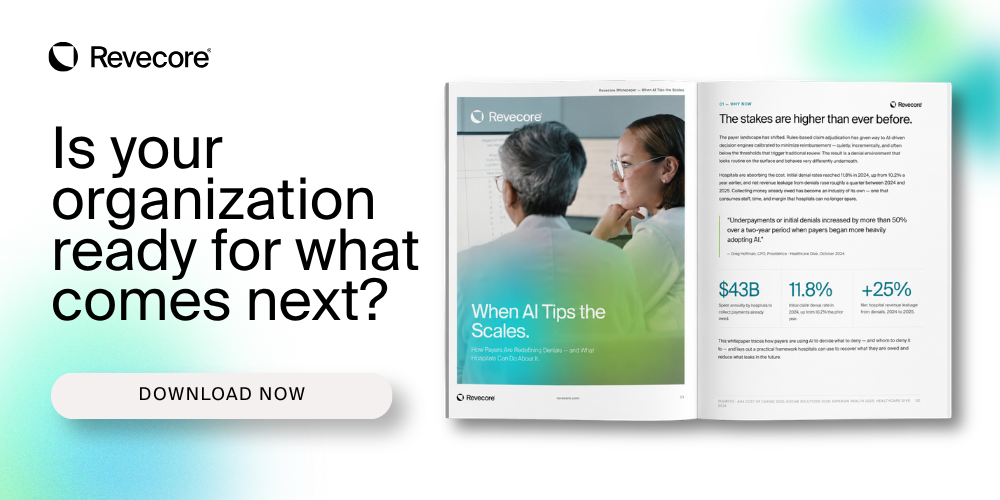
Curious what AI-supported analytics looks like across the full recovery lifecycle — from denial prediction to underpayment recovery? Our whitepaper breaks down how Revecore combines human expertise with AI to help hospitals and health systems recover revenue faster and more accurately.
Similar Content
-

- Revecore Insights
Why Complex Claims Need a Different Revenue Cycle Strategy
September 17, 2026
-

- Revecore Insights
One in Five Insured Patients Was Denied Care Last Year. Hospitals Are Absorbing the Fallout.
September 16, 2026
-

- Revecore Insights
Where the Other Half of Your Underpayments Are Hiding
September 10, 2026


